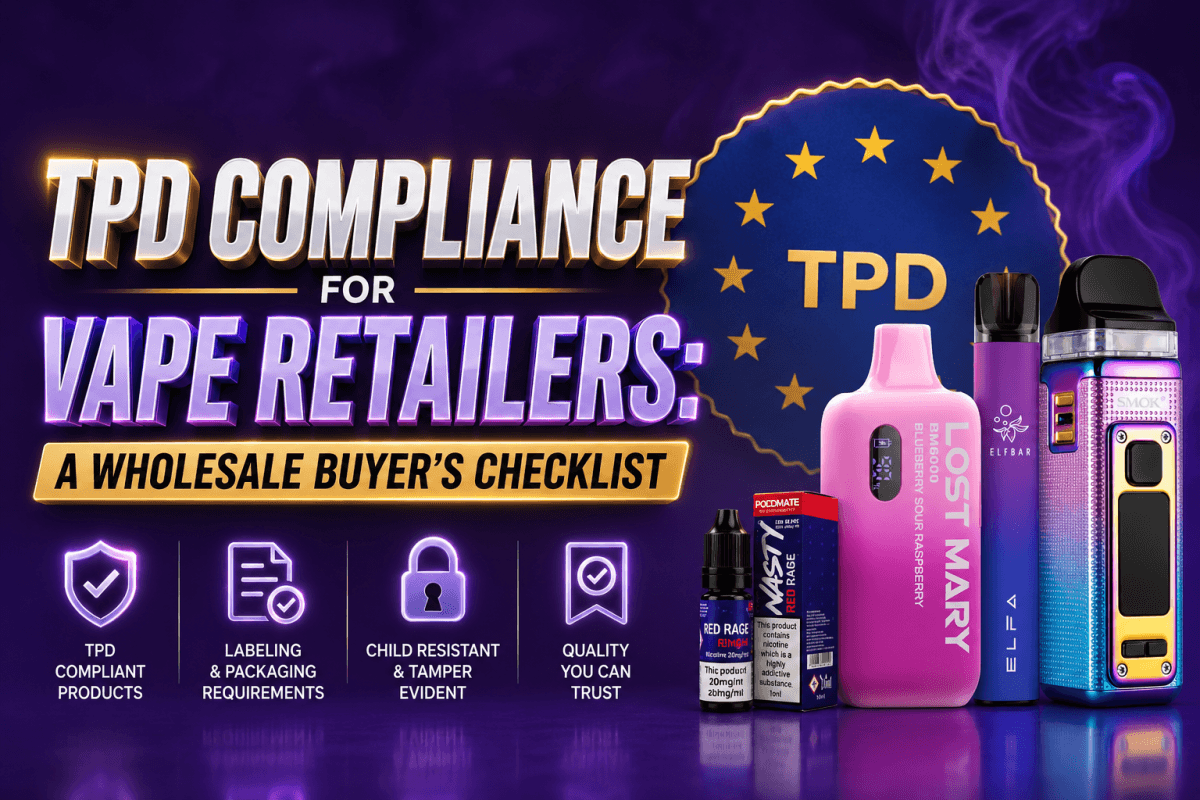
TPD Compliance for Vape Retailers - Buyer's Checklist
Tags Cloud
Every vaping product legally sold in the UK must comply with the Tobacco and Related Products Regulations (TRPR) — the UK's implementation of the EU Tobacco Products Directive (TPD) — which caps nicotine strength at 20mg/ml, limits tanks to 2ml and refill bottles to 10ml, and requires every product to be notified to the MHRA before it can be sold. For a retailer, buying non-compliant stock isn't a minor technicality — the liability for selling it sits with your shop, not just your supplier. This checklist covers exactly what to verify before placing a wholesale order.
What is the Tobacco Products Directive (TPD)?
The Tobacco Products Directive is an EU regulatory framework that was brought into UK law through the Tobacco and Related Products Regulations 2016 (TRPR), and it remains the legal baseline for e-cigarettes and e-liquids in the UK today, unchanged by Brexit. According to the MHRA's own guidance, the rules exist to ensure minimum safety and quality standards, give consumers the information they need to make informed choices, and create an environment that protects children from starting to use these products.
For a wholesale buyer, the practical point is this: TPD compliance isn't a box-ticking exercise for manufacturers alone — every product on your shelf needs to meet these standards, and as the retailer selling it, you carry real responsibility for what you stock.
Nicotine strength and tank/bottle size limits
The TRPR sets hard numerical limits that apply across every compliant product in the UK:
- Maximum nicotine strength: 20mg/ml
- Maximum tank or pod capacity: 2ml
- Maximum refill container (bottle) volume: 10ml
- Nicotine-containing products and their packaging must be child-resistant and tamper evident
- Certain ingredients — including colourings, caffeine, and taurine — are banned outright
These limits apply regardless of format, whether you're stocking nic salts, freebase e-liquids, or prefilled pods. Any product exceeding these thresholds — a pod claiming more than 2ml capacity, or a bottle over 10ml, for example — isn't legally sellable in the UK regardless of what the packaging claims about performance.
Labelling and health warning requirements
Beyond the numerical limits, TPD-compliant products must carry specific labelling and be sold with an information leaflet containing prescribed safety instructions, warnings, and UK-based contact details. Packaging must include a statement that the product is not recommended for use by young people and non-smokers, alongside the standard nicotine health warning.
A tactile warning for visually impaired users is also a legal requirement on nicotine-containing products, given how toxic nicotine can be on contact or ingestion at high concentrations. This is one of the easiest compliance checks a retailer can run visually before stock even reaches the shelf — if a product is missing these labelling elements, it shouldn't be sold.
MHRA product notification: who's responsible
Every e-cigarette and e-liquid product must be notified to the MHRA and published on their official notified products list before it can legally be sold in the UK. This notification obligation sits with the producer — defined as anyone who manufactures, imports, or re-brands a product as their own — not with retailers selling an already-notified product.
This is genuinely useful to understand as a retailer: you don't need to submit notifications yourself for products you simply stock and sell, but you do need confidence that whoever supplied that product — your wholesaler, and the manufacturer behind them — has done so correctly. A wholesaler unable to confirm notification status on request is a clear compliance gap, not a minor administrative detail.
How to check if wholesale stock is TPD-compliant
Before committing to a large wholesale order, there's a simple set of checks worth running on any new product or supplier:
- Ask your wholesaler directly to confirm the product is notified to the MHRA and currently published on their list
- Check tank, pod, and bottle sizes against the 2ml and 10ml limits
- Confirm nicotine strength doesn't exceed 20mg/ml on any nicotine-containing line
- Check packaging for the required health warning, non-smoker advisory, and tactile warning
- Confirm an information leaflet with UK contact details is included
A wholesaler that stocks only compliant, MHRA-notified products should be able to answer these questions clearly and specifically, product by product — not with a vague general assurance. This is worth treating as a genuine filter when comparing suppliers, not an afterthought once price has already been agreed.
What happens if you sell non-compliant products
If Trading Standards finds non-compliant stock in your shop — incorrect tank sizes, missing warnings, unnotified products — the liability sits with the retailer selling it, regardless of what your supplier told you at the point of purchase. This is a meaningful reason to treat compliance as a non-negotiable filter when choosing who to buy from, rather than assuming any wholesaler's stock is automatically safe to sell.
It's also worth noting that all vapes sold in the UK must be refillable and rechargeable, since single-use disposable vapes were banned from 1 June 2025 — another compliance point worth checking on any device stock, not just e-liquid.
Want stock you can trust is compliant from the start? Open a Noviq Distribution trade account to browse our full vape kits, nic salts, and e-liquids ranges, or get in touch with our trade team about a specific product's compliance status.