Vape Wholesale UK: The Complete Buying Guide (2026)
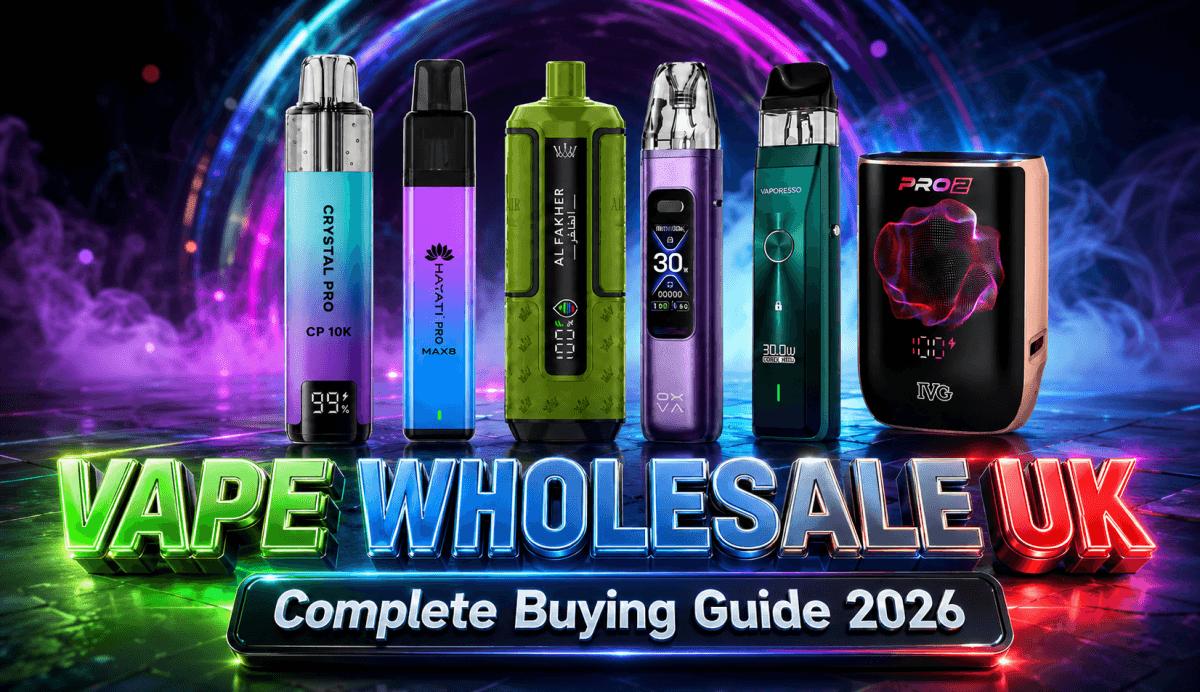
Everything a UK vape shop owner needs to know before placing a wholesale order — how trade accounts work, what TPD compliance actually requires, and how to choose a distributor that won't leave your shelves empty.
Tags Cloud
Vape wholesale in the UK means buying vaping products — pod kits, nic salts, shortfills, and nicotine pouches — in bulk from a registered trade distributor at prices below RRP, so retailers have room for a profit margin when they sell individual units on to customers. This guide covers everything a UK shop owner or convenience store buyer needs to know before opening a trade account: how wholesale pricing works, which suppliers suit which shop size, what TPD compliance actually requires, and how to choose a distributor like Noviq Distribution that won't leave your shelves empty.
What is vape wholesale, and how does it actually work?
Every vaping product a UK customer buys in-store has passed through a supply chain with three distinct layers: the manufacturer that makes it, the wholesaler that distributes it, and the retailer that sells it to the end customer. Vape wholesale sits in that middle layer, and understanding how it works is the difference between running a shop on healthy margins and constantly firefighting stock problems.
A manufacturer — the company behind a brand like Elf Bar, Lost Mary, or IVG — produces devices and e-liquid at factory scale, usually in quantities far beyond what a single shop could ever use. They sell that stock in bulk to distributors, who then break it down into retailer-sized trade orders and sell it on at a wholesale price, which sits below the recommended retail price (RRP) by enough margin for the retailer to make a profit once they sell it on individually.
This is why almost no independent UK vape shop buys directly from manufacturers. Manufacturer minimum order quantities are built for wholesale-scale buyers, not single-shop stock levels, and most manufacturers don't want the administrative overhead of managing thousands of small retail accounts individually. A distributor solves both problems: retailers get manageable order sizes, and manufacturers get one large account to service instead of thousands of small ones.
For a retailer, the practical benefit is consolidation. Instead of separate supplier relationships, minimum spends, delivery schedules, and invoices for Elf Bar, Lost Mary, IVG, and nicotine pouches, a wholesaler like Noviq Distribution lets you order all of it through one trade account, one delivery, and one invoice.
How to open a vape wholesale trade account in the UK
This is one of the most-searched phrases among first-time vape shop buyers, and for good reason — the process isn't always clearly explained on wholesaler websites. Here's what it typically involves.
First, eligibility. Trade accounts are reserved for registered, trading businesses — not individual consumers. You'll usually be asked to confirm your business is legally allowed to sell age-restricted vaping products, which in practice means having a registered business (sole trader, partnership, or limited company) and, in many cases, a VAT number, though VAT registration thresholds mean some smaller shops won't have one yet — most wholesalers accommodate this with alternative proof of trading.
Second, documentation. Have the following ready before you start an application, as it speeds up approval significantly:
- Company registration number (if a limited company) or sole trader/partnership details
- VAT number, if registered
- Proof of business address
- Evidence of an existing or planned retail premises or online store selling age-restricted products
Third, verification. Most distributors run a manual or semi-automated check before approving a new trade account — this protects the wholesaler from selling into channels that shouldn't have access to bulk vaping stock, and it protects retailers by keeping the supply chain compliant. Approval times vary, but a well-run distributor should turn this around within one to two business days if your documentation is complete.
Once approved, you'll get access to trade pricing, the full wholesale catalogue, and usually a named account contact for ongoing support. Ready to get started? Register for a Noviq Distribution trade account to begin the verification process.
Vape wholesale suppliers with no minimum order — what small shops need to know
This is one of the most common frustrations for small and newly-opened shops: many wholesalers set minimum order values that suit established, high-turnover retailers, but shut out smaller buyers who need to test demand before committing to large stock orders.
A genuinely low-barrier wholesaler structures its minimums around realistic starting stock levels — enough to make a delivery cost-effective for both sides, but not so high that a new shop is forced to overbuy stock it can't turn over before it ages. If you're comparing suppliers on this point specifically, ask directly: what is the minimum order value, does it apply per order or per product line, and are there lower thresholds for a first order versus repeat orders?
It's also worth understanding why minimums exist at all — they're not arbitrary. Distributors have real per-order costs (picking, packing, delivery), and a very small order can genuinely cost more to fulfil than it earns. The trade-off smaller shops should look for is a wholesaler with a fair, transparent minimum rather than no minimum at all, since "no minimum" suppliers sometimes compensate with worse per-unit pricing or slower dispatch for small orders. For more on right-sizing your order to your shop's actual turnover, see Bulk Buying Vapes: How Much Should Your Shop Order Each Month?
Wholesale vape pod kits for shops: what to stock and why
Pod kits are the backbone of most UK vape shop and convenience store ranges, particularly since the UK's disposable vape ban pushed demand toward rechargeable, disposable-style pod devices. When buying wholesale, the decision isn't just "which brand" — it's about matching device type to your actual customer base.
Prefilled pod kits — devices that come with a sealed, ready-to-use pod already loaded with e-liquid — suit shops with high footfall from customers who want the closest experience to a disposable vape without the environmental and regulatory issues that led to the ban. These move fastest in convenience stores and shops near transport hubs, where speed of purchase matters more than customisation.
A good example of this category in practice is the Hayati Pro Max Plus vape kit, sold wholesale in a box of 5 — a prefilled, disposable-style pod device from a brand that consistently ranks among the UK's best-selling. Once a device like this is on your shelf, the matching refill pods, such as the Hayati Pro Max Plus 6000 refill pods, pack of 5, become a repeat-purchase line in their own right. For the full Hayati vape kits and Hayati refill pods ranges, along with a deeper look at why the brand performs so well at retail, see our Hayati vape wholesale buying guide.
Refillable pod kits, where the customer buys the device once and then buys e-liquid separately, suit a different customer: someone building an ongoing relationship with your shop rather than a one-off purchase. These customers return for pods, coils, and e-liquid repeatedly, which makes refillable kits a stronger long-term revenue driver even though the upfront device sale is less frequent.
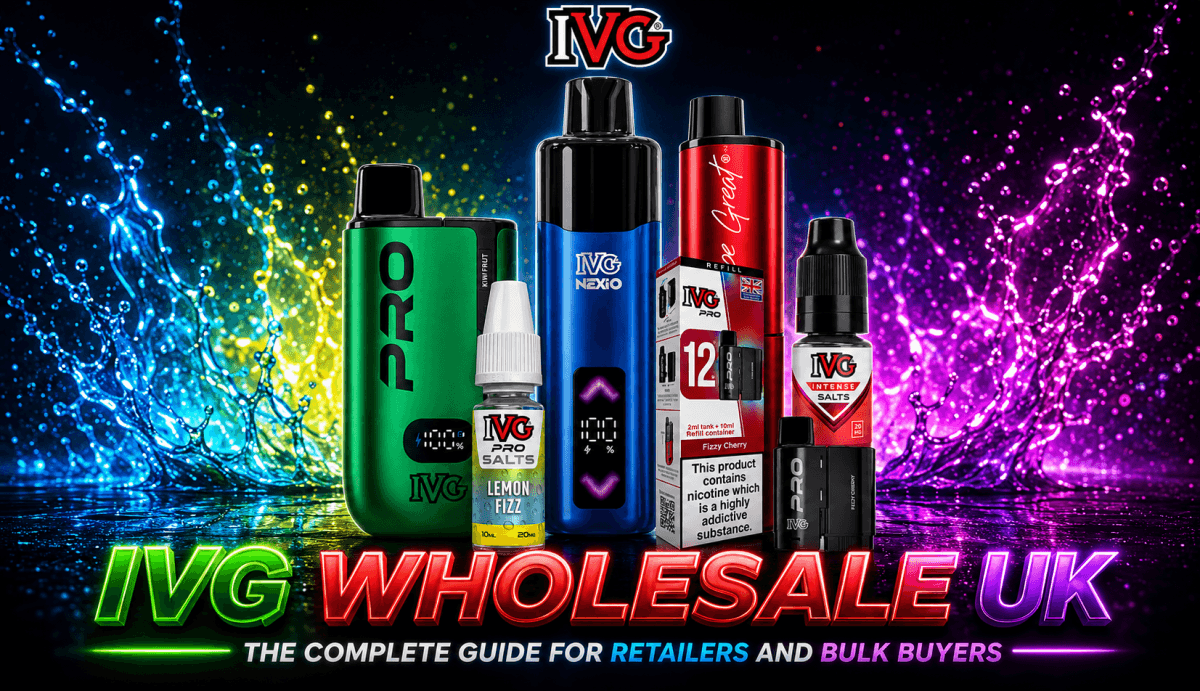
A balanced wholesale order typically blends both: enough prefilled stock to capture impulse and convenience purchases, and enough refillable kits and accessories to build the repeat-customer base that keeps your shop's revenue predictable month to month. For a deeper look at two of the UK's most consistently strong-selling brands, see our Lost Mary vape wholesale buying guide and IVG vape wholesale buying guide.
Wholesale nic salts supplier: sourcing e-liquid that actually sells
Nicotine salt e-liquids ("nic salts") remain one of the highest-turnover categories for UK vape retailers because they pair naturally with the pod kits driving most of today's sales — nic salts deliver a smoother throat hit at higher nicotine strengths than freebase e-liquid, which suits the low-powered pod devices most customers now use.
When sourcing nic salts wholesale, three things matter beyond the brand name: nicotine strength range, flavour breadth, and bottle size. UK regulation caps nicotine salt e-liquid at 20mg/ml, and stock should cover the common strength tiers customers actually ask for — typically 10mg and 20mg see the most consistent demand, with a smaller allocation of lower strengths for customers reducing intake.
Flavour breadth matters more in nic salts than almost any other vaping category, because repeat purchase behaviour is heavily flavour-driven — a customer who finds "their" flavour will often reorder the same bottle for months. This means a wholesale order should weight toward proven, consistently-reordered flavours (fruit and menthol/ice profiles typically lead) while still carrying enough range to avoid turning away a customer whose preferred flavour you don't stock.
It's also worth understanding how nic salts differ from freebase nicotine and shortfill e-liquids in your ordering split, since stocking the wrong ratio of each wastes both shelf space and cash flow. For the full comparison and a recommended stocking split by shop type, see Nic Salts vs Freebase E-Liquid: A Stocking Guide for Retailers, and for the shortfill and nic-shot side of the category, E-Liquid Shortfills Explained: A Wholesale Buying Guide.
Nicotine pouches wholesale: the category retailers are adding fastest
Nicotine pouches have moved from a niche add-on to one of the fastest-growing categories on UK vape shop counters, and searches like "nicotine pouches wholesale supplier UK" reflect a real shift in what retailers are actively trying to add to their range right now — not just replace.
Part of the appeal for retailers is margin and shelf efficiency: pouches take up minimal counter space relative to their price point, have a longer shelf life than e-liquid, and appeal to a customer segment — including some non-vapers — that a pure vape range doesn't reach. For shops with limited floor space, pouches often deliver a stronger sales-per-square-foot return than adding another e-liquid flavour wall.
Stocking strategy for pouches should mirror the same logic as e-liquid nicotine strength tiers: cover the full spread from mild through to strong and extreme, since pouch customers tend to be more strength-loyal than vape customers, and stocking only the middle of the range will quietly lose you the customers at either end. Brand-wise, a handful of names dominate reorder volume in the UK market, and a wholesale order should weight toward those proven performers before diversifying into smaller or newer brands.
For a full breakdown of strength tiers, leading brands, and how to merchandise pouches alongside your vape range, see Nicotine Pouches Wholesale: The Fastest-Growing Category in 2026.
TPD compliant vape wholesaler: why this matters more than price
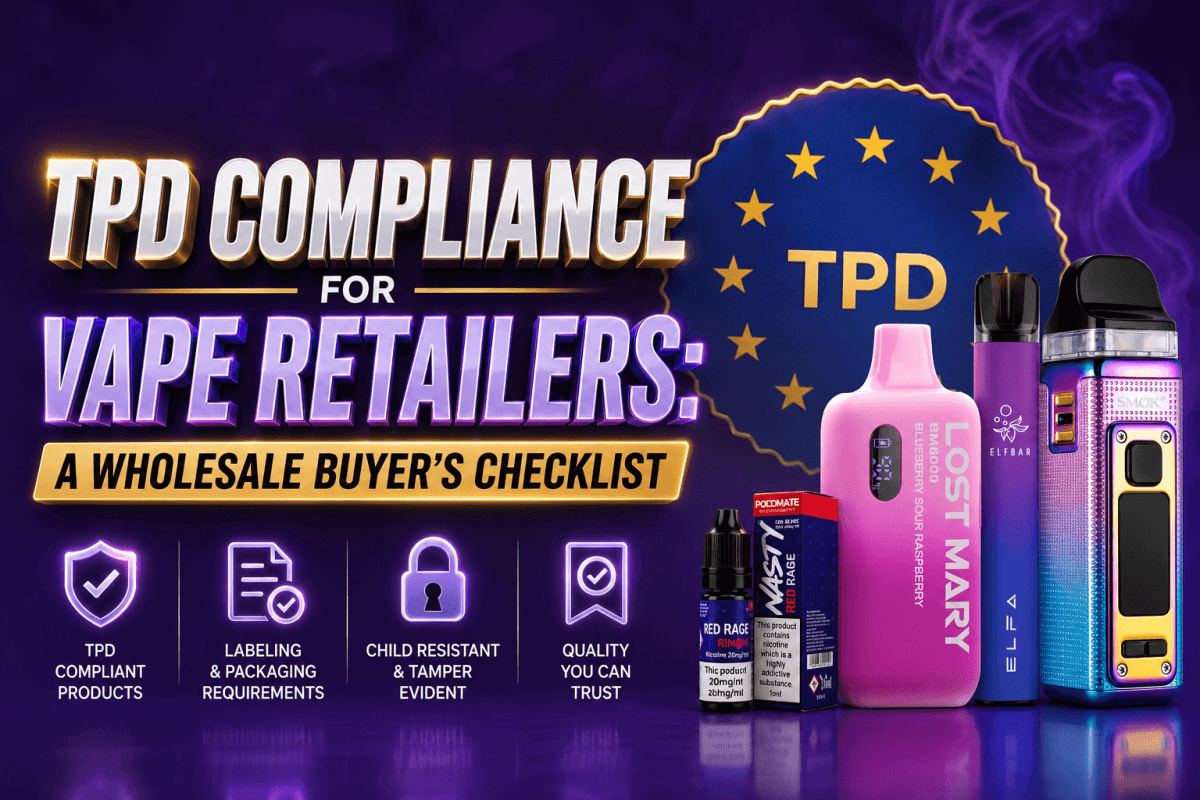
Every legally-sold vaping product in the UK must comply with the Tobacco Products Directive (TPD) — rules covering maximum nicotine strength, tank and bottle size limits, packaging and health-warning requirements, and mandatory notification to the MHRA (Medicines and Healthcare products Regulatory Agency) before a product can be sold. This isn't optional guidance; it's the legal baseline for every product on your shelf.
For a retailer, the risk of buying from a non-compliant or careless wholesaler isn't abstract. If Trading Standards finds non-compliant stock in your shop — wrong tank sizes, missing health warnings, unnotified products — the liability sits with the retailer selling it, not just the supplier who provided it. This is why "cheapest supplier" and "safest supplier" are not always the same distributor, and why compliance should be a non-negotiable filter before price ever enters the comparison.
A properly compliant wholesaler will be able to confirm, product by product, that stock is MHRA-notified and meets current TPD limits, and should be transparent about this rather than treating it as a minor detail. If a distributor can't answer compliance questions clearly and specifically, that's a stronger warning sign than any pricing comparison. For the full retailer-facing checklist, see TPD Compliance for Vape Retailers: A Wholesale Buyer's Checklist, and for how this interacts with age verification and Trading Standards enforcement more broadly, Age Verification & Trading Standards: A Retailer's Compliance Guide.
Next-day vape wholesale delivery: why dispatch speed decides your reorder rate
It's easy to underweight delivery speed when comparing wholesalers on paper, but it's often the single biggest factor in how much revenue you actually keep. Every day your bestselling flavour or device is out of stock because a reorder hasn't arrived is a day of lost sales that customer may simply take to a competitor instead of waiting.
"Next-day delivery" as a marketing phrase doesn't always mean the same thing between suppliers — the real question is what the order cut-off time is, how consistently that promise is kept during high-demand periods, and what happens when a courier delay occurs. A distributor worth building a long-term relationship with will be upfront about cut-off times and realistic about exceptions, rather than making a blanket promise that quietly fails during busy weeks.
For retailers managing multiple reorder points across a wide product range, it's also worth asking whether a wholesaler supports partial or split deliveries, since waiting for one delayed product to hold up an entire order can be just as costly as a slow dispatch. See Next-Day Trade Delivery: Why Dispatch Speed Matters for Vape Shops for the full list of questions worth asking before you commit to a supplier on delivery promises alone.
"Cheapest vape wholesale supplier UK" — why that's the wrong question
This is one of the highest-volume searches among new vape shop buyers, and it's worth addressing directly, because chasing the lowest unit price in isolation is one of the most common early mistakes independent retailers make.
Unit price only tells part of the cost story. A slightly cheaper wholesale price that comes with slower delivery, higher minimum orders, inconsistent stock availability, or weaker compliance assurances can end up costing a shop far more in lost sales, wasted staff time chasing missing deliveries, or — in the worst case — compliance penalties, than the saving on the invoice itself.
The more useful question is total cost of ownership across a supplier relationship: unit price, minimum order flexibility, delivery reliability, compliance assurance, and account support combined. A distributor that's marginally more expensive per unit but consistently in stock, fast to deliver, and easy to reach when something goes wrong will almost always outperform the cheapest option on actual shop profitability over a full trading year. For a full framework on evaluating suppliers beyond price, see How to Choose a Reliable Vape Distributor in the UK and How to Spot a Reliable vs Unreliable Vape Supplier.
Choosing wholesale stock by shop type
The right wholesale order looks different depending on what kind of retail business you're running, and one of the most common mistakes new trade accounts make is copying a generic "bestseller list" without adapting it to their own customer base.
Convenience stores and newsagents with vaping as a secondary category typically do best prioritising prefilled pod kits and a tight, high-turnover flavour range — customers here are buying on impulse or convenience, not browsing extensively, so a smaller but well-chosen range often outperforms a wide one that ties up cash in slow-moving stock.
Specialist vape shops, by contrast, benefit from a wider range across device types, including refillable and advanced kits that build repeat, higher-spend customers over time. These shops can justify carrying more of the accessory and consumable categories — coils, replacement pods, and a broader e-liquid flavour wall — because their customers are actively browsing and comparing rather than grabbing the first familiar option.
Independent shops competing against larger chains have a particular pricing challenge worth planning around directly — see Independent Vape Shop vs Chain: How Wholesale Pricing Levels the Field for how the right trade account structure can close that gap. And for the device-type decision specifically, Vape Pod Kits vs Sub-Ohm Kits: What Sells Best in Convenience Stores breaks down exactly which category suits which shop footprint.
Vape wholesale pricing and margin: what retailers should expect
Understanding realistic margin expectations before you place your first order prevents two common problems: underpricing stock out of uncertainty about what the market will bear, or overpricing it and losing sales to competitors offering the same product cheaper.
Margins vary meaningfully by category. Devices and kits typically carry a different margin structure to consumables like e-liquid and pouches, partly because consumables drive repeat purchases and are often priced more competitively to keep customers returning, while devices are more frequently the subject of promotional pricing or bundle deals to drive initial footfall.
Order volume also directly affects your cost price — most wholesalers offer tiered trade pricing, where committing to larger or more frequent orders lowers your per-unit cost. This creates a genuine trade-off worth planning deliberately: ordering just enough to meet immediate demand keeps cash flow tight but flexible, while ordering in larger volume to hit better pricing tiers ties up more cash but improves margin on every unit sold. The right balance depends on your shop's actual turnover rate, not a generic rule of thumb. For the full margin breakdown by category and how to build a pricing strategy around it, see Vape Wholesale vs Retail: Understanding Margins for Shop Owners and Multibuy & Bundle Deals: Wholesale Pricing Strategies That Move Stock.
Switching vape wholesale suppliers without disrupting your shop
Retailers searching for a new wholesaler are often doing so because an existing supplier relationship has broken down in some way — inconsistent stock, slow delivery, or a pricing change that's eroded margin. Switching doesn't have to mean a stock gap, but it does need planning.
The safest approach is running both accounts briefly in parallel: place a first trial order with the new distributor covering your highest-turnover lines while your existing supplier still covers the rest, so a single delayed first delivery doesn't leave you short. Once the new supplier has proven reliable on speed, accuracy, and stock availability across a couple of orders, it becomes far safer to consolidate fully and close out the old account.
It's also worth being direct with a prospective new distributor about why you're switching — a wholesaler confident in their own reliability will welcome the conversation, while one that's evasive about your specific concerns (delivery speed, stock consistency, compliance) is telling you something worth listening to before you commit fully.
Ready to see trade pricing for your shop? Open a Noviq Distribution trade account and get access to our full vape wholesale catalogue, or get in touch if you'd like to talk through the right stock mix for your shop before you order.